
Add surge protection at the panel
Tell us about the property and any generator or panel work planned, and we will put the options in writing.
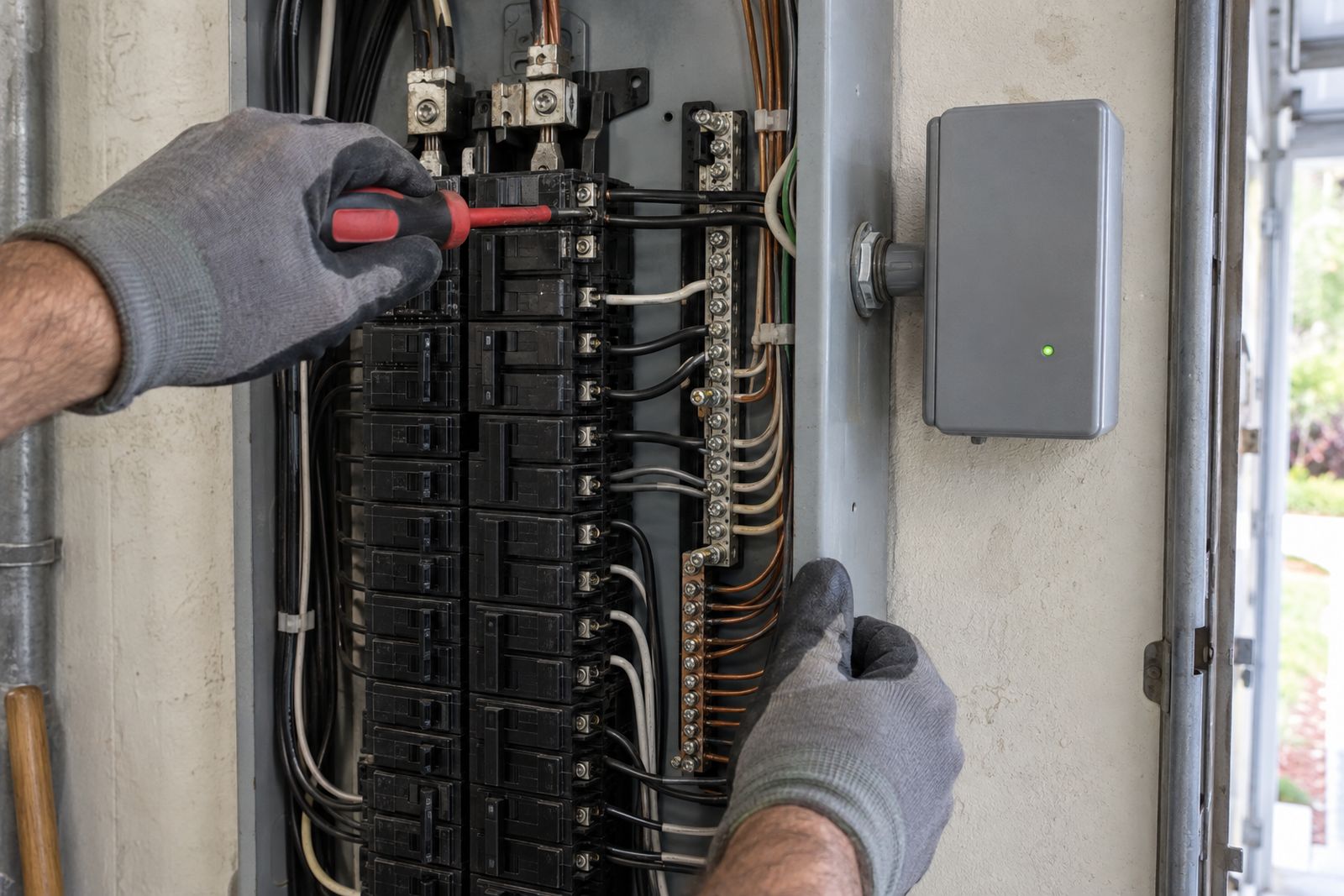
Shop for a whole-house surge protector and you meet "Type 1" and "Type 2" almost at once. Both are surge protective devices (SPDs) wired into your electrical service, not plugged into a wall; the difference is where each one is allowed to connect. Here is how to choose between a Type 1 and a Type 2 surge protector, and what the label is telling you.
For most Florida homes, either type can meet the code if it sits at the service equipment. A Type 2 device at the main panel is the common choice; a Type 1 is the one to use when it has to go on the line side of the main breaker, at or near the meter. Which is right depends on where your meter, main disconnect and panel are, and on what work is being done. Then add plug-in protection at your most sensitive electronics.
UL 1449, the US safety standard for surge protective devices, sorts them by where they can be installed.
Types 4 and 5 are components built into other products. In practice, a Type 1 device can go where a Type 2 is called for, but not the reverse, and some products are listed for both.
In many South Florida homes the meter and main disconnect sit on an outside wall, with the main panel beside them or in the garage. A Type 1 device can mount at the meter and main disconnect and catch a surge before it reaches the main breaker. A Type 2 usually mounts on the side of the main panel and lands on a breaker inside it. For both, short and straight leads matter: the longer the wire to the panel's bus, the more voltage gets past.
Whole-house units are sold by kA per phase: 60, 100, 120 and up. That is the surge current capacity, the largest single surge the device is rated to handle on each phase. The protective parts wear a little with every surge, so more capacity generally means a longer working life, which counts for something in a lightning-heavy climate.
What kA does not tell you is how much voltage reaches your equipment. That is the voltage protection rating (VPR) on the UL label, where lower is better. The label also lists a nominal discharge current (In), the surge the device must survive repeatedly in testing. Compare all three, not just the biggest number.
Most whole-house units have status lights that show whether protection is still active. The parts inside sacrifice themselves to absorb surges, and after one large surge, or years of smaller ones, they can be used up. With many designs the power stays on when that happens, so the lights may be the only sign. Check them after a nearby strike, a hurricane or a long outage, and replace the device if they show a fault.
Surge protection works best in layers. The device at the service takes the large spikes arriving from the utility. What gets past it is smaller, and surges made inside the house by motors and compressors can reach nearby outlets before they reach the panel, so a good Type 3 protector at the TV, computer and network equipment helps with the remainder.
Cable, satellite and phone lines also enter the house separately from the power, and a surge can ride in on them. Point-of-use protectors with coax and network ports cover those paths; a power-only device at the electrical panel does not.
A home with a standby generator adds electronics to its service: the generator's controller and the automatic transfer switch. It also switches between two power sources at every outage. Placement takes more thought, too. Depending on how the transfer switch is wired, at the service entrance or downstream of the main panel, a single surge protector may not be connected to the circuits the generator feeds.
That is a good reason to plan surge protection with the generator installation rather than after it. We offer it as an add-on during a generator installation or a service visit; our whole-house surge protection page lists the models we install.
Since its 2020 edition, the National Electrical Code has required a surge protective device on services supplying dwelling units (section 230.67). It must be Type 1 or Type 2, built into the service equipment or installed immediately next to it, and the rule applies when service equipment is replaced, not only in new construction. The Florida Building Code adopted the 2020 NEC with its 8th edition (2023).
So if you are building, replacing a service or having an electrical panel upgrade or changeout, expect a surge protector to be part of the job, at the service equipment: in many Florida homes, the main breaker in the outdoor meter-main rather than the panel indoors. Where the service is not being touched, the rule generally does not reach back; ask your building department or us how it applies to your property.
Talk to an electrician if you are planning a generator, a panel changeout or a new service, if your panel has no surge protector, or if the lights on an existing unit show a fault. Alternate Power Solutions installs Type 1 and Type 2 devices for homes and businesses in Palm Beach, Martin and St. Lucie counties under State Certified Electrical Contractor license EC13002031. See our whole-house surge protector installation options. Ask about an estimate when you are ready.
Tell us about the property and any generator or panel work planned, and we will put the options in writing.