
Planning a tank or a gas line?
Tell us what the gas needs to feed and where the property is, and we will scope the job for a written estimate.
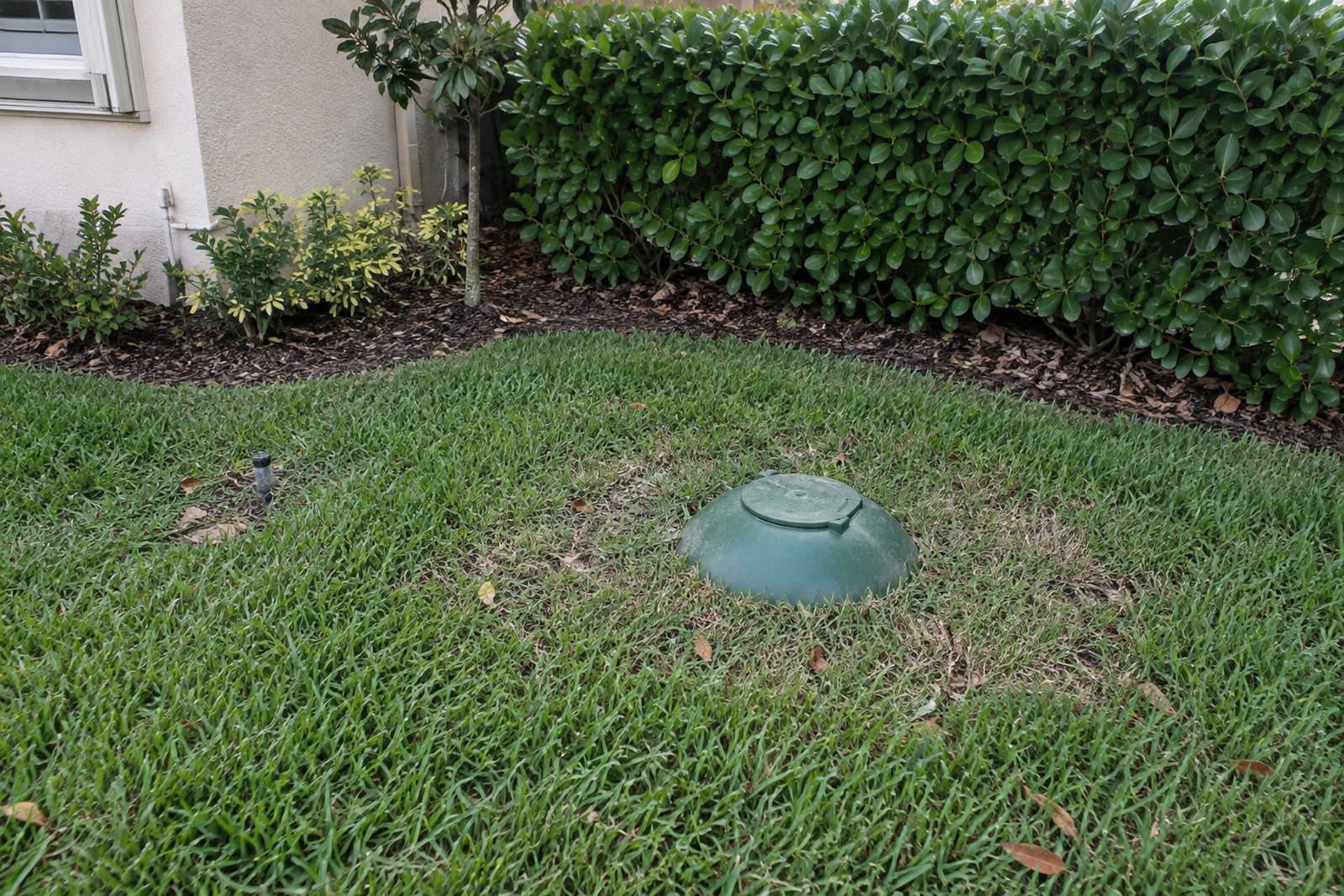
If your standby generator will run on propane, the tank is its fuel supply for every outage, and you have two decisions to make about it: whether it goes underground or sits above ground, and how big it should be. This guide covers both, along with the permit, HOA and storm-season questions Florida homeowners tend to ask. When you want to price one, our propane tank installation page explains what the job includes.
Choose an underground tank when appearance matters, when your homeowners' association restricts visible equipment, or when there is nowhere sensible to hide a tank. Choose an above-ground tank when you want less site work and a visible tank is acceptable, or can be screened. Either type feeds a generator in the same way, both need a permit, and both have to meet the code on where they can go.
The tank goes into a hole in the yard, and once it is backfilled only a low access dome shows at lawn level. Under the lid you typically find the fill connection, the gauge and the service valve. The trade-off is site work: a hole has to be dug, the tank set and backfilled, and the lawn or surface over it has to recover. Digging conditions, such as a high water table, and access for the machine both affect the estimate.
The tank rests on a level base, usually in a side or back yard. There is less digging, although the line to the generator or house may still be trenched, and the tank is easy to get at. It is also in plain view, so screening with planting or a fence is worth planning where your association and the code allow it. In Florida, securing it against storm winds belongs in the design conversation.
Residential tanks commonly come in 120, 250, 500 and 1,000-gallon sizes. None is filled to the brim: the fill stops at about 80% of capacity, leaving room for the liquid to expand as it warms, so a full tank holds less than the number on it:
Runtime is roughly the usable gallons divided by the generator's fuel use at the load you expect:
Runtime (hours) ≈ usable gallons ÷ gallons per hour at your expected load
Here is a purely hypothetical example with round numbers. Suppose a generator's spec sheet listed 3 gallons per hour at half load. A full 500-gallon tank, about 400 usable gallons, would give roughly 400 ÷ 3 ≈ 133 hours, a little over five and a half days of continuous running. The same generator would get roughly 67 hours from a 250-gallon tank and roughly 267 hours from a 1,000-gallon tank. Run the arithmetic on a 120-gallon tank and it comes out at about 32 hours.
Those figures illustrate the method; they are not a prediction for any model. Use the fuel consumption table on your own generator's spec sheet, and then adjust for real life:
Decide how many days without power you want to cover, then work back to a tank size. When a house has no gas, our estimate is built around a tank sized for the runtime you choose.
Where a tank can go is not only a matter of preference. NFPA 58, the national propane code, and your local authority set the clearances between a tank and buildings, windows and doors, property lines and sources of ignition, and those rules differ between buried and above-ground tanks and between sizes. The municipality reviews the position as part of the permit. That is why placement should be confirmed for your lot, not estimated over the phone.
If you have a homeowners' association, read its rules on tanks, screening and excavation early. Its approval is separate from the building permit and runs on its own timetable. An underground tank's low dome may make that conversation easier, but only the association can say yes.
A propane tank only helps in an outage if there is propane in it. The Atlantic hurricane season runs from June 1 to November 30, and the sensible time to top up is before it starts, not when a storm is already in the forecast and suppliers may be stretched. Check the gauge (on an underground tank it is usually under the dome lid) and ask your propane supplier which refill arrangements suit a generator that may sit unused for months.
Water and wind both matter. Groundwater can lift a buried tank that is not held down, and storm winds act on a tank that sits above ground, so either type may need anchoring. What your site needs is set by code and the local authority, and it is worth asking about before you choose a tank type.
Alternate Power Solutions installs underground and above-ground propane tanks and the gas lines that feed a standby generator or the house, under Licensed Gas Contractor #24513, which covers propane and natural gas. We pull the gas permit and arrange the inspection. Our price is for supplying and installing the tank; propane is bought separately, and the office can coordinate the first fill with a supplier. We do not deliver or refill propane.
Call us when you are planning a standby generator and need to settle the fuel, when you already know you want a tank, or when you need a line run to a new gas appliance location. See propane tank installation for what the job includes, our gas and propane services for what we do and do not do, and standby generator installation if the generator is still to be chosen. We serve Palm Beach, Martin and St. Lucie counties. Ask about an estimate.
Tell us what the gas needs to feed and where the property is, and we will scope the job for a written estimate.